Stage 0 — Foundations
Goal: understand what QA actually is, how software gets built, and where testing fits — so everything later makes sense.
1. What QA actually is (and isn’t)
| Term | What it means | Example |
|---|---|---|
| Quality Assurance (QA) | Process-oriented. Preventing defects by improving how software is built | Adding a review checklist before code merges |
| Quality Control (QC) | Product-oriented. Finding defects in the built product | Executing test cases on a release candidate |
| Testing | The activity of executing software to find defects | Clicking through checkout with an expired card |
The mindset shift that makes you good: developers ask “how do I make this work?” — testers ask “how could this break?” Your job is not to prove the software works. Your job is to find the truth about its quality and communicate it clearly.
2. The Seven Testing Principles (ISTQB — but explained like a human)
- Testing shows the presence of defects, not their absence — you can never prove software is bug-free; you reduce risk.
- Exhaustive testing is impossible — a 10-field form has millions of input combos. That’s why test design techniques exist (Stage 1).
- Early testing saves money — a requirement bug caught in review costs minutes; the same bug in production costs a rollback, support tickets, and trust.
- Defects cluster — 80% of bugs live in 20% of modules. Find the hot spots (payment, auth, anything recently rewritten) and hit them hardest.
- The pesticide paradox — re-running the same tests stops finding new bugs. Refresh and vary your tests.
- Testing is context-dependent — you test a healthcare app differently than a game. (I tested payment systems at Mastercard — the tolerance for defects was effectively zero.)
- Absence-of-errors fallacy — a bug-free product that solves the wrong problem is still a failure.
3. SDLC — how software gets built
Software Development Life Cycle phases (every model arranges these differently):
Requirements → Design → Development → Testing → Deployment → Maintenance
| Model | How it works | Where QA fits |
|---|---|---|
| Waterfall | Phases run once, in order | QA gets the product at the end (risky — bugs found late) |
| Agile/Scrum | 1–2 week sprints, ship increments | QA is embedded in the team, tests every sprint (this is your reality — see Stage 4) |
| V-Model | Each dev phase has a matching test phase | Test design starts as soon as requirements exist |
4. STLC — the testing life cycle
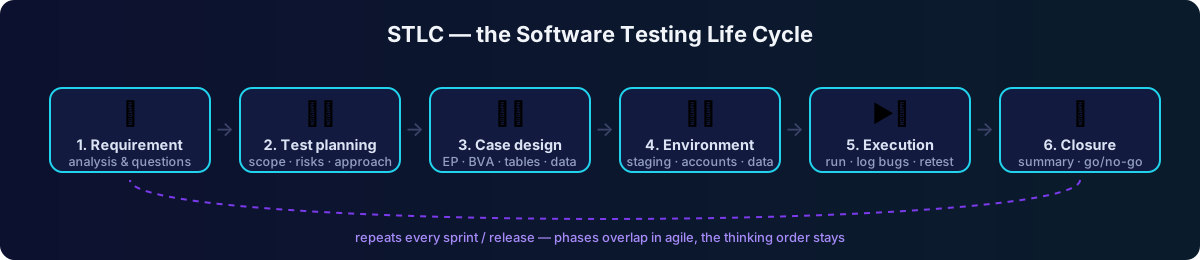
Software Testing Life Cycle — what you do, phase by phase:
| Phase | Activity | Output |
|---|---|---|
| 1. Requirement analysis | Read the story/spec, ask questions, find ambiguity | Clarified requirements, testability notes |
| 2. Test planning | Decide scope, approach, people, schedule, risks | Test plan |
| 3. Test case design | Apply design techniques to write cases | Test cases, test data |
| 4. Environment setup | Get a stable place to test (staging, test accounts, data) | Ready environment |
| 5. Test execution | Run the cases, log defects, retest fixes | Execution results, bug reports |
| 6. Closure | Summarize: what was tested, what’s still risky | Test summary report, go/no-go input |
Real-world truth: in agile these phases compress into days and overlap constantly. The order of thinking still holds.
5. Verification vs Validation
- Verification — are we building the product right? (reviews, walkthroughs, checking against spec)
- Validation — are we building the right product? (actually executing it, UAT)
6. The vocabulary that must be automatic
| Term | Meaning |
|---|---|
| Error | Human mistake in code or requirements |
| Defect / Bug | The flaw in the software caused by the error |
| Failure | The defect actually manifesting during execution |
| Test case | Preconditions + steps + expected result |
| Test suite | A collection of related test cases |
| Test scenario | A high-level thing to test (“verify checkout with expired card”) |
| Regression | Re-testing existing features after changes |
| Severity | How bad the defect’s impact is (set by QA) |
| Priority | How urgently it should be fixed (set with product) |
✅ Exercise
Take any app you use daily (e.g., a food delivery app). Write down:
- Three ways it could fail that would be critical severity
- Three defects that would be low severity but high priority (hint: a typo in the company name on the home page)
- Which testing principle explains why the app still has bugs despite a QA team
Next → Stage 1: Test Design Techniques