🎯 Capstone — Get Hired as a Sr. QA (the Modern Ladder)
Goal: the single page that ties the whole roadmap together into one climb — from “I’ve never tested” to a Senior QA / SDET offer, using the modern Manual + Automation + AI + MCP stack. Every rung says exactly what to learn, what to build, and how to prove it. Do the rungs in order; don’t skip. This is the ladder I climbed and the one I hire against.
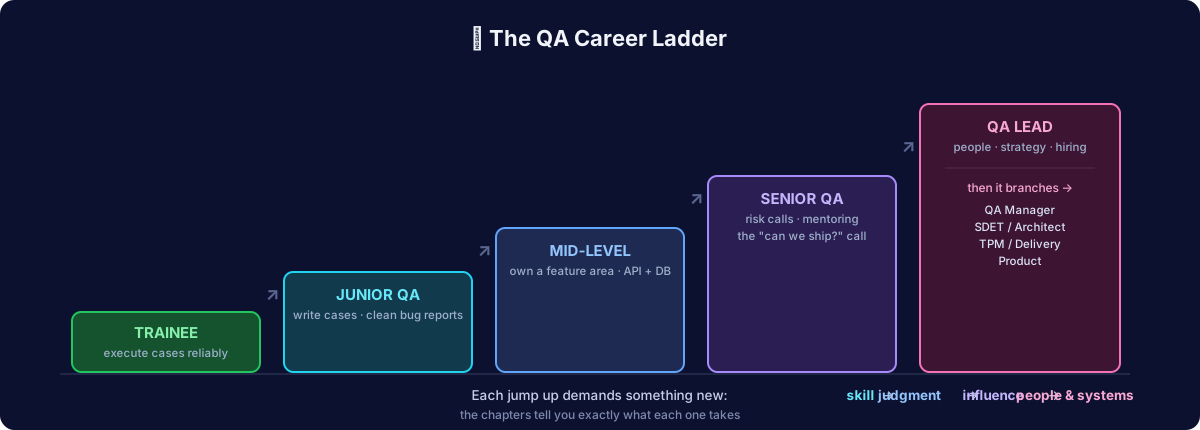
How to use this page
Each rung = Learn → Build → Prove. Learn links the chapter. Build is the thing you make. Prove is the public artifact that goes in your portfolio (a repo, a report, a collection). By the last rung you’ll have 6–8 real artifacts — that portfolio is what actually gets the Sr. QA offer, not a certificate.
When the artifacts are ready, package the evidence using the QA Resume & CV tutorial: Junior, Mid, Senior QA and SDET versions are mapped separately, with an ATS-safe master template.
🎓 Want this as guided video + a certificate? Every rung maps to a course on AZADEMY (QA Automation · AI · Playwright · Python · Freelancing). The roadmap is the free textbook; the academy is the classroom.
🟢 Rung 1 — Think like a tester (Manual foundations)
- Learn: Foundations · Test Design Techniques · Test Artifacts
- Build: a test plan, 25–40 test cases (naming the techniques: EP, BVA, decision tables), and 5 polished bug reports for SauceDemo.
- Prove: a public “manual-qa-portfolio” repo. 🏅 Artifact #1.
🟢 Rung 2 — Cover the whole surface (Testing types & process)
- Learn: Types of Testing · QA in Agile Teams · The QA Toolbox
- Build: run a full risk-based cycle on Automation Exercise — functional, cross-browser, negative — with a one-page test summary and a go/no-go call.
- Prove: the test summary report + a DevTools/HAR-backed bug. 🏅 Artifact #2.
🟡 Rung 3 — Go under the UI (API + data)
- Learn: API Testing Deep Dive
- Build: a Postman collection against restful-booker — CRUD + auth + negatives, all four assertion layers — runnable via Newman. Add 5 SQL checks that prove UI ↔ database agreement.
- Prove: the collection repo + a README of the bugs found. 🏅 Artifact #3. This rung alone separates you from most manual-only testers.
🟡 Rung 4 — Automate (the pyramid, done right)
- Learn: Path to Automation · Automation Deep Dive
- Build: a Playwright + TypeScript suite (Page Object Model, data-driven) covering 8–10 SauceDemo regression cases, running in GitHub Actions on every push, with the HTML report uploaded.
- Prove: a repo with a green CI badge. 🏅 Artifact #4. “My tests block merges on failure” is a Sr.-level sentence.
🔴 Rung 5 — Break it at scale (Performance + Security)
- Learn: Performance Testing · Security Testing
- Build: a k6 load + spike test against test.k6.io with pass/fail thresholds and a percentile report; and find one Broken Access Control + one XSS on a local OWASP Juice Shop, written up ethically.
- Prove: a k6 report + two security bug reports. 🏅 Artifacts #5–6.
🔴 Rung 6 — Work with AI + MCP (the 2026 differentiator)
- Learn: AI × QA
- Build: use AI on real QA tasks (test-case generation, bug-report cleanup, log analysis — verifying every output), drive a browser with an MCP + Playwright agent (setup below), and build one eval for an AI feature with promptfoo.
- Prove: a write-up: what the agent caught vs missed, which generated assertions you kept, and your eval results. 🏅 Artifact #7. Almost no candidate has this — it’s your edge.
🔴 Rung 7 — Lead & communicate (what makes it “Senior”)
- Learn: Soft Skills · Career Journey · Interview Preparation
- Build: a risk-based test strategy doc, a mentoring/README that teaches your framework, and prepared STAR interview stories.
- Prove: the strategy doc + polished LinkedIn/GitHub presence. 🏅 Artifact #8.
🤖 How AI + Automation + MCP actually work together
This is the modern Sr. QA daily loop — the thing interviewers now ask about. AI does the volume; you own the verdict.
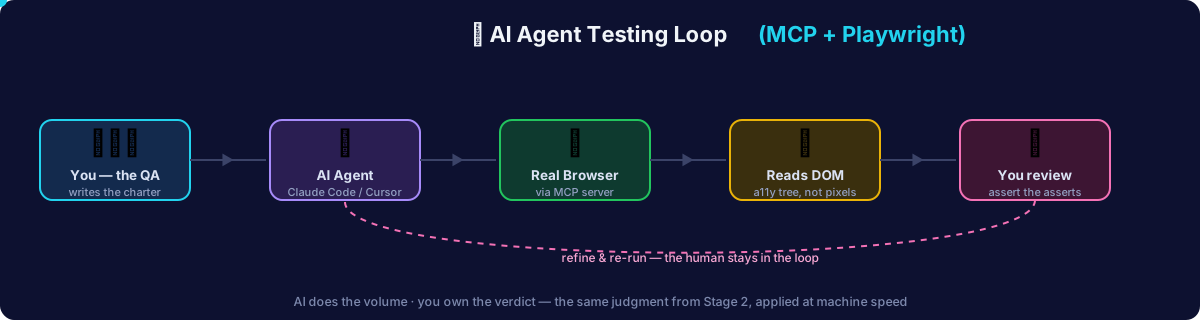
- You set intent — a charter: “Explore checkout with expired cards and coupon stacking; report anything broken.”
- An MCP-connected AI agent (Claude Code / Cursor) drives a real browser via the Playwright MCP server — clicking, typing, reading the accessibility tree (not screenshots).
- The agent explores + drafts tests — it walks the app like a tireless junior and emits candidate Playwright specs.
- You review — the actual QA job — you check the assertions assert the right things (AI loves asserting “page loaded” and calling it coverage). You keep the good, cut the noise.
- CI runs it — the suite lands in GitHub Actions; Playwright’s healer proposes fixes when locators drift; you approve.
- Evals guard AI features — if the product has LLM features, an eval set scores every prompt/model change (relevance, accuracy, safety) the way regression guards code.
The mindset: everything in Rungs 1–5 matters more in this loop, because judgment is the scarce skill. AI amplifies a good tester and exposes a weak one.
MCP + Playwright — step-by-step setup (5 minutes)
# 1. Add the official Playwright MCP server to your AI client (Claude Code shown)
claude mcp add playwright -- npx @playwright/mcp@latest

# 2. Confirm it's connected
claude mcp list
Then just ask your agent, in plain English:
“Open https://www.saucedemo.com, log in as standard_user, add a backpack to the cart, check out, and tell me anything that looks broken. Then generate a Playwright test for the happy path.”
The agent opens a real browser, does it, reports findings, and writes a spec. You review the spec, harden the assertions, and commit it. That’s the loop. (Full detail, auth/Shadow-DOM gotchas, and the tool landscape: AI × QA.)
✅ The Sr. QA readiness checklist
You’re ready to interview for Senior QA / SDET when you can honestly tick most of these:
Craft
- Design a minimal, high-coverage test suite from a vague requirement (EP/BVA/decision tables/state)
- Write a bug report a dev reproduces in one read
- Make a go/no-go call with a risk table and defend it
Technical
- Test an API end-to-end (status/body/headers/side-effects) and cross-check with SQL
- Build & maintain a Playwright/Selenium suite with POM, running in CI
- Run a load test with percentile thresholds and read the results
- Find the common OWASP bugs (IDOR, XSS) and escalate responsibly
Modern / AI
- Use AI to accelerate QA tasks and judge its output critically
- Drive a browser with an MCP + Playwright agent and review generated tests
- Explain how you’d test an AI/LLM feature (evals, hallucination, prompt-injection)
Leadership
- Set QA strategy and release gates; track escape rate & flake rate
- Communicate risk to non-QA stakeholders without blame
- Mentor a junior / improve a process with evidence
Proof
- A public portfolio with 6–8 real artifacts (the rungs above)
🗓️ The 6-month plan (evenings & weekends)
| Month | Rungs | Outcome |
|---|---|---|
| 1 | 1–2 | Manual portfolio + full test cycle |
| 2 | 3 | API collection + SQL checks |
| 3 | 4 | Playwright suite green in CI |
| 4 | 5 | k6 report + security findings |
| 5 | 6 | AI/MCP workflow + one eval |
| 6 | 7 | Strategy doc, interview prep, apply |
Move faster if you already have some rungs. The order matters more than the speed.
The bottom line: a certificate says you attended; this portfolio says you can do the job. Climb the rungs, build the artifacts, and you won’t be asking for a Sr. QA role — you’ll be choosing between offers.
🎓 Do it with structure, video and a certificate → AZADEMY. 📬 Stuck or want a portfolio review? azantor.xyz · open an issue.
← Back to the roadmap