Stage 6 — The Career Journey: Junior → Lead (and beyond)
Goal: know exactly where you are, what the next level requires, and how to get hired at each step. This is the path I walked — QA Engineer → QA Lead → Sr. Automation & Reliability Engineer → Technical Project Manager & founder.
The ladder
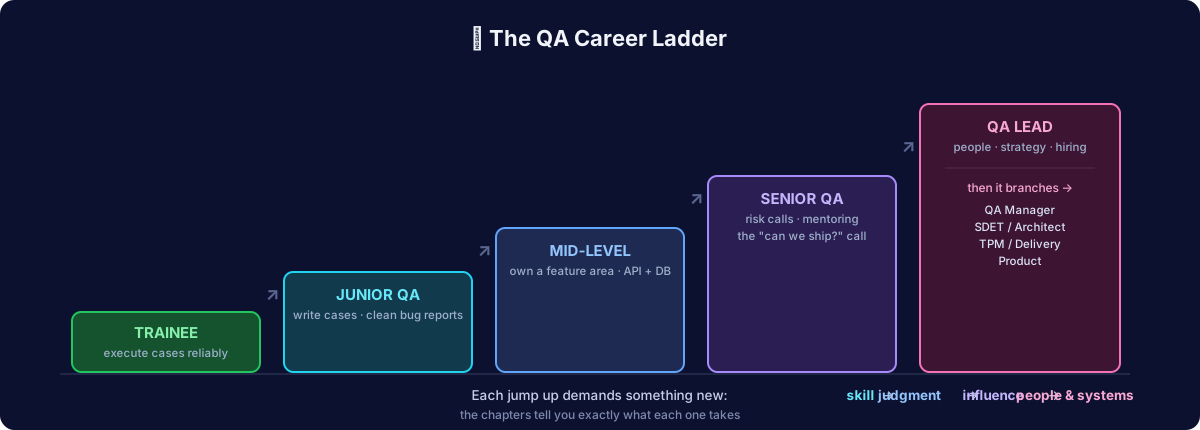
| Level | Years (typical) | What you own | What gets you promoted |
|---|---|---|---|
| Trainee / Intern | 0–1 | Executing test cases someone else wrote | Reliability: every result recorded, every bug reproducible |
| Junior QA | 0–2 | Writing test cases from acceptance criteria, regression runs, clean bug reports | Bugs devs can reproduce in one read; asking sharp questions in refinement |
| Mid-level QA | 2–4 | A feature area end-to-end: strategy, design, execution, sign-off; API + DB testing | Judgment — risk-based decisions; finding the bugs behind the UI |
| Senior QA | 4–7 | Release quality across a team; mentoring; process design; the “can we ship?” recommendation | Influence — preventing bug classes, not just finding instances; metrics that change behavior |
| QA Lead | 5–9 | The QA function: people, strategy, hiring, stakeholder trust | Building a team that runs without you; the escape rate trend line |
| Then it branches → | QA Manager / Head of Quality (people & org) · QA Architect / SDET (deep technical) · TPM / Delivery (my route) · Product |
The honest truth about each jump:
- Junior→Mid is about skill (Stages 0–5 of this repo, practiced daily)
- Mid→Senior is about judgment (risk, prioritization, saying “no” with evidence)
- Senior→Lead is about people and systems (your output becomes the team’s output)
Certifications — worth it or not?
| Cert | Verdict |
|---|---|
| ISTQB Foundation (CTFL) | ✅ Worth it early — HR filters on it in many markets, and the vocabulary is the industry standard |
| ISTQB Agile / Advanced | Situational — useful if your employer pays |
| Random Udemy certificates | ❌ Not as credentials — take courses for knowledge, list skills instead |
A portfolio beats every certificate. Which brings us to…
Build a portfolio that gets interviews
Hiring managers (I am one — I’ve built QA teams and run technical hiring) want evidence you can do the job:
- A public test-artifact repo — pick a well-known site (e.g., a demo store like saucedemo.com), write: a one-page test plan, 25–40 test cases using named techniques (“BVA on quantity field”), 5 polished bug reports for real bugs you found. Structure it like this repo.
- A bug journal — screenshots + write-ups of real bugs you find in the wild. Ten good entries = infinite interview stories.
- Exploratory session notes — 3 charter-based sessions showing structured thinking.
- (Later) API collection — a Postman collection with negative cases against a public API.
Getting the first job
- Apply for: QA Trainee, Junior QA, Test Analyst, Manual QA Engineer, Software Tester
- Where juniors actually get hired: local software agencies & outsourcing firms, startups (they need generalists), internships, crowdtesting (uTest/Testlio — real experience while you apply)
- Freelance route: small manual-testing gigs on Upwork build both skill and proof — I’m Top Rated with 23/23 five-star jobs; it compounds
- Resume rule: every line = action + object + evidence. “Wrote 120 test cases using EP/BVA for a checkout flow; found 14 defects pre-release including a double-charge bug” beats “responsible for testing”
The daily habit stack (what actually compounds)
- 📅 Daily: test something deliberately for 20 minutes; log one bug or one observation
- 📅 Weekly: one chapter/topic deep-dive (this repo → then MoT articles, Testing conferences on YouTube)
- 📅 Monthly: update the portfolio; write one short post about a bug you found (LinkedIn is a career accelerant in QA — recruiters live there)
When people say “manual QA is dying”
They said this in 2015, 2019, and every year since. What actually happens: pure test-execution roles are shrinking; testing thinking is now the differentiator. Automation executes checks; humans design them, explore, and judge risk. The move that keeps you permanently employable is Stage 8 — layering API skills, then automation, then AI-assisted testing on top of a rock-solid manual foundation. The foundation IS this repo.
Next → Stage 7: Interview Preparation