Stage 4 — QA in Agile Teams
Goal: operate inside a real sprint — where testing is continuous, requirements are conversations, and you are the team’s risk radar.
1. Your week in a Scrum team
| Ceremony | Your job there |
|---|---|
| Backlog refinement | The highest-leverage hour of your week. Ask the questions that become bugs later: “What happens if the coupon expires mid-checkout?” Push for testable acceptance criteria |
| Sprint planning | Estimate testing effort with dev estimates, flag test-data/environment needs early |
| Daily standup | Surface blockers fast (“staging is down, 6 cases blocked”) and risk, not just status |
| Review/demo | You often demo — you know the edge cases that impress stakeholders |
| Retro | Bring data: “8 of 12 bugs this sprint were requirement gaps — let’s fix refinement” |
2. The Definition of Done includes QA
A story is NOT done when the code is merged. A healthy DoD:
- Acceptance criteria verified on staging
- Negative & boundary cases executed
- Regression on touched areas passed
- No open critical/high defects
- Test cases updated in the suite
Fight for this in writing. “Done in dev” ≠ done.
3. The defect lifecycle
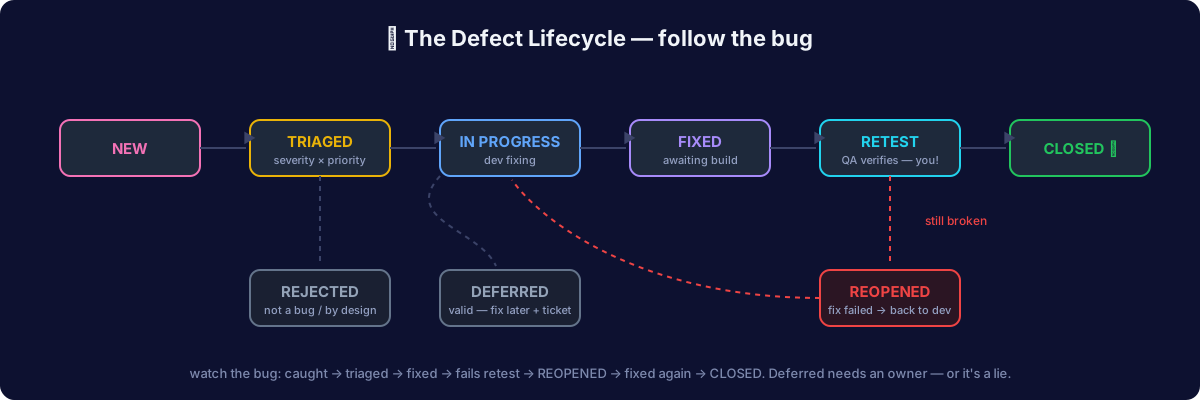
Triage is where severity meets business priority. Come prepared: reproduction rate, affected user %, workaround exists or not. You’re the evidence, product is the judge.
4. Entry & exit criteria — release gates
I run releases with explicit gates (this saved the FUR4 5-portal program more than once):
Entry (testing starts): build deployed to staging · smoke suite green · previous blockers verified · test data seeded Exit (we can ship): 100% of P1 cases executed · ≥95% pass rate overall · zero open critical/high · known issues documented & signed off by product
No gate, no discipline — “we’ll test it in prod” becomes the process.
5. QA metrics that actually matter
| Metric | Formula | What it tells you |
|---|---|---|
| Defect escape rate | prod bugs ÷ (prod + pre-release bugs) | Is your net catching things? The single most honest QA metric |
| Defect density by module | bugs per feature/module | Where to focus next cycle (defect clustering!) |
| Requirement-gap ratio | bugs traced to unclear requirements | Ammunition to improve refinement |
| Test execution progress | cases run ÷ planned, daily | Burndown for the release conversation |
| Reopen rate | reopened ÷ fixed | Fix quality / repro quality signal |
Avoid vanity metrics: raw bug counts and “number of test cases written” reward the wrong behavior.
6. Risk-based testing — the senior skill
You never have time to test everything. Score each area Impact × Likelihood (1–3 each):
| Area | Impact | Likelihood (recent change?) | Score | Depth |
|---|---|---|---|---|
| Payment capture | 3 | 3 (provider swapped) | 9 | Full suite + exploratory + data checks |
| Product search | 3 | 1 (untouched) | 3 | Smoke only |
| Footer links | 1 | 1 | 1 | Skip this round |
Present this table when someone asks “can we ship Friday?” — it turns a feeling into a decision.
7. Shift-left in practice (what it means for a manual QA)
- Review designs/mockups for edge cases before code exists (“what does the empty state look like?”)
- Write test scenarios from acceptance criteria the day the story is refined
- Pair with the developer for 15 minutes before they merge — cheapest bugs you’ll ever find
- Sit in on API design and flag untestable contracts
✅ Exercise
Your team must ship in 2 days. 40 test cases remain: 10 payment, 10 profile-settings, 10 admin reports, 10 email templates. The payment provider SDK was upgraded this sprint. Write your risk table and defend what you’ll skip.
Next → Stage 5: The QA Toolbox